AccessibilityADA Title IIIUnruh Act
ADA Website Lawsuit and Settlement Examples
What a website accessibility complaint looks like, which laws it cites, what a small settlement can cost, and what to do if a demand letter arrives.
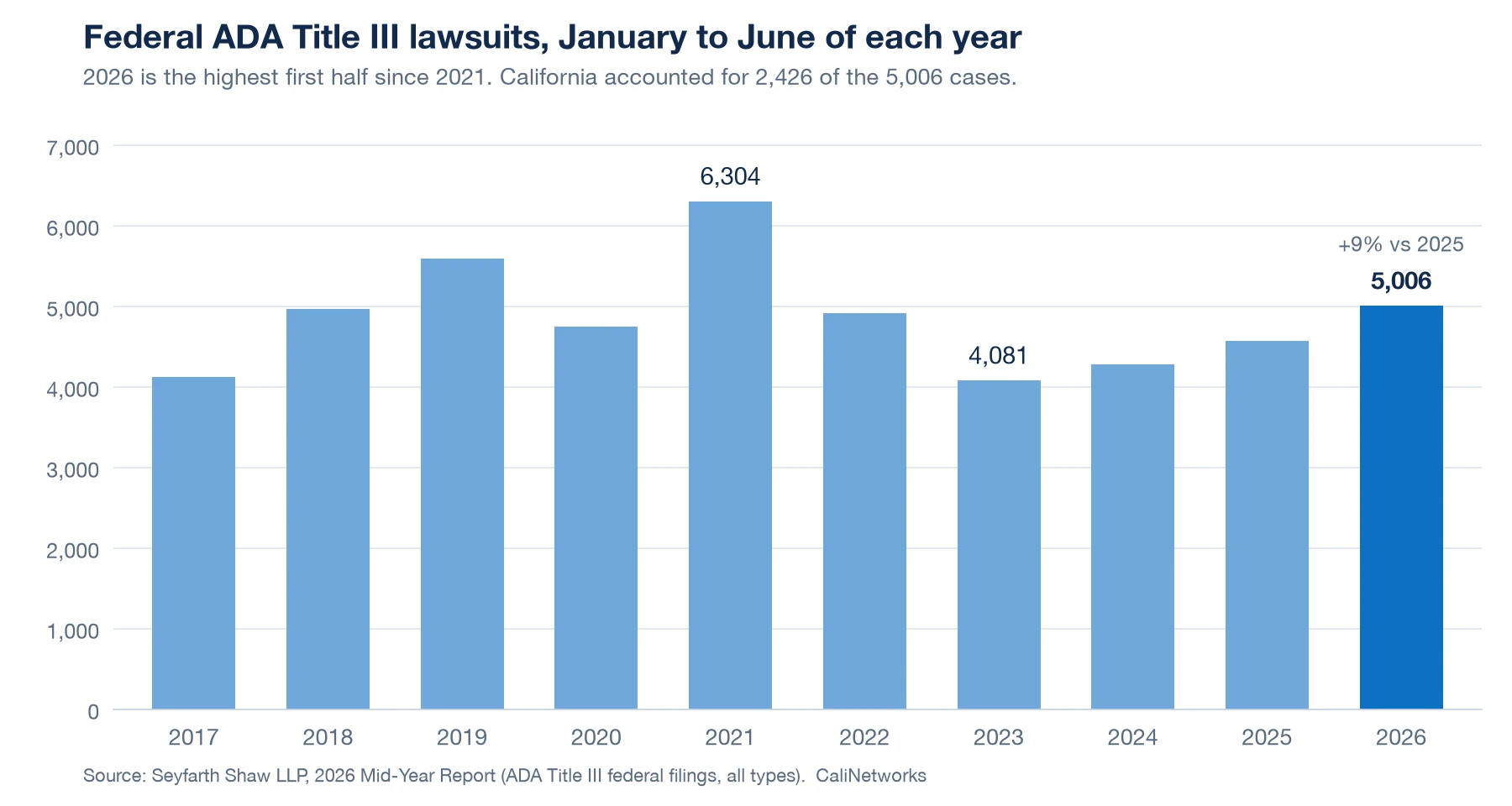
- Filings keep rising: 5,006 federal ADA Title III suits in the first half of 2026.
- California adds damages: at least $4,000 per violation under the Unruh Act.
- Fixing the site is the answer: audit, remediate, and document.
Certified and trusted since 2001 5.0 client rating Google Partner

Website accessibility lawsuits are no longer rare, and most of them are filed against ordinary small and mid-sized businesses. A typical claim says that a person with a disability, often a blind visitor using a screen reader, could not use part of a website, and that this violates the Americans with Disabilities Act (ADA) and, in California, the Unruh Civil Rights Act.
This page shows what a real complaint looks like, which laws these claims cite, what a small settlement can cost, and what to do if a demand letter or lawsuit arrives. It is general information, not legal advice. If you have been served, speak with an attorney before you do anything else.
The Trend in ADA Website Lawsuits
Filings have grown for most of the past decade and rose again in 2026.
- 5,006 federal ADA Title III lawsuits were filed in the first half of 2026, up 9% from the same period in 2025 and the highest mid-year total since 2021, according to Seyfarth Shaw.
- California led every state with 2,426 of those cases, followed by Florida, Illinois, and New York.
- 3,117 federal website accessibility suits were filed in 2025, a 27% increase over 2024.
- Repeat targets are common. In October 2026, UsableNet logged 431 new web accessibility suits, and 97 of those defendants had been sued over digital accessibility before.
- Widgets did not prevent suits. 107 of the October defendants were using a third-party accessibility widget or overlay when they were sued.
These figures cover federal court only. Many California claims are filed in state court or settled after a demand letter, so the real number is higher. See our review of CIPA and ADA lawsuits in 2026.
What to Do If You Receive a Demand Letter or Lawsuit
1. Call an attorney
Do not ignore the letter and do not respond on your own. Deadlines are short, and an attorney experienced in ADA and Unruh claims can evaluate the claim and negotiate.
2. Audit the website
Have the site tested against WCAG Level AA, with automated scanning plus manual keyboard and screen reader testing of the pages named in the complaint.
3. Fix the barriers
Remediate the issues in the site's code, content, and design. Adding a widget does not resolve the claim. Coordinate timing with your attorney.
4. Document everything
Keep dated audit reports, a record of each fix, and a published accessibility statement. This supports your defense and helps prevent the next claim.
Have not been sued? Do steps two through four now. A dated record showing your site was tested and corrected is far cheaper than a settlement.
What an ADA Website Lawsuit Looks Like
The excerpts below come from a complaint filed against a small business in a California superior court. Names and case details are redacted. Every case is different, so treat these as an illustration of the kinds of issues plaintiffs call out.
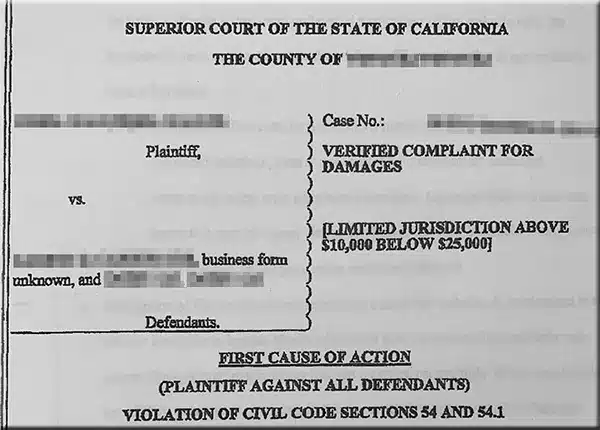
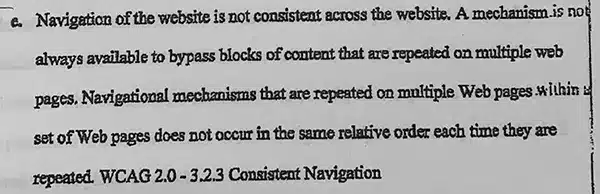



This complaint cited WCAG 2.0. Newer complaints usually cite WCAG 2.1 or 2.2, but the issues are the same ones that appear again and again: missing alternative text, low color contrast, unlabeled form fields, empty links and buttons, and pages that cannot be used with a keyboard.
Laws Commonly Cited in Website Accessibility Claims
| Law | Citation | Why it matters |
|---|---|---|
| ADA Title III | 42 U.S.C. 12181 to 12189, including Section 302 (42 U.S.C. 12182) | Prohibits discrimination by places of public accommodation. A private plaintiff can obtain a court order to fix the site and attorney fees, but not money damages. |
| ADA findings and definitions | 42 U.S.C. 12101 and 12102 | Set out the purpose of the ADA and define disability. Usually cited at the start of a federal complaint. |
| Unruh Civil Rights Act (California) | Civil Code Sections 51 and 52 | Treats an ADA violation as a violation of California law and adds statutory damages of at least $4,000 per violation, plus attorney fees. |
| Disabled Persons Act (California) | Civil Code Sections 54 and 54.1 | Guarantees people with disabilities full and equal access. Often pleaded alongside or instead of Unruh. |
| ADA Title II | 28 C.F.R. Part 35 | Applies to state and local governments. A 2024 federal rule requires their websites and apps to meet WCAG 2.1 Level AA. |
| Section 508 | 29 U.S.C. 794d | Applies to federal agencies and their technology vendors. It is sometimes mentioned in complaints, but it does not govern private business websites. |
There is still no federal regulation that sets a technical standard for private business websites. Courts and settlements look to WCAG Level AA, which is why it is the practical target. Learn more about the WCAG standard.
Notable ADA Website Cases
Robles v. Domino's Pizza (2019)
The Ninth Circuit held that the ADA applied to Domino's website and mobile app because they connect customers to its physical restaurants. The Supreme Court declined to review the decision later that year.
Gomez v. GNC (2018)
A federal court in Florida found the retailer's website violated the ADA because a blind customer using a screen reader could not add items to the cart, use the store locator, or read promotions.
Gil v. Winn-Dixie (2017 to 2021)
A trial court ruled against the grocery chain over its inaccessible website. The Eleventh Circuit reversed in 2021 and later vacated its own opinion as moot, which left the question unsettled in that circuit.
Acheson Hotels v. Laufer (2023)
The Supreme Court was asked whether a "tester" who never intended to book a room could sue over a hotel website. The Court dismissed the case as moot without deciding, so tester lawsuits continue. Read our article on the case.
Courts do dismiss weak claims. See our summary of Erkan v. Hidalgo, in which a court dismissed a website accessibility lawsuit.
What Does a Settlement Cost?
In one small business case we are familiar with, the claim settled for $1,000, and the attorney fees came to between $3,000 and $4,000. The legal bill was several times the settlement, and the website still had to be fixed afterward.
That example is at the low end and is not an industry average. In California, Unruh damages start at $4,000 per violation, a complaint may allege more than one violation, and a business can face more than one claim from more than one plaintiff. Every case is different, so ask your attorney what to expect in yours.
Fixing the website first is almost always the cheaper path.
Businesses that are sued most often
- Online stores and other e-commerce sites
- Restaurants, hotels, and other hospitality businesses
- Medical, dental, and other healthcare practices
- Retailers, car dealerships, and service businesses with a storefront
- Entertainment venues, gyms, and salons
- Schools, real estate firms, and financial services
- Any small local business with online booking or ordering
Need Help With ADA Compliance?
CaliNetworks audits websites against WCAG 2.2 Level AA, fixes the underlying code, content, and design issues, and provides the documentation you and your attorney need. We work with counsel when a claim is already open, and we help businesses that have not been sued stay that way.
Contact an ADA Compliance Expert
Or call (805) 409-7700. Related guides: ADA website compliance, plugins and testing tools, and color contrast checkers.
ADA Website Lawsuit Questions
Can a small business really be sued over its website?
Yes. Most website accessibility claims are filed against small and mid-sized businesses, including restaurants, retailers, medical practices, and online stores. Business size is not a defense.
What should I do first if I receive an ADA demand letter?
Contact an attorney who handles ADA and Unruh Act claims before you respond. Then have the website audited and begin fixing the issues, coordinating the timing with your attorney.
Will an accessibility widget or overlay protect my website from a lawsuit?
No. Widgets and overlays do not fix the underlying code, and many businesses have been sued while using one. Remediating the site itself is the reliable approach.
How much are damages in a California website accessibility case?
The federal ADA allows a court order and attorney fees but no money damages for private plaintiffs. California's Unruh Civil Rights Act adds statutory damages of at least $4,000 per violation, plus attorney fees, which is why so many claims are filed in California.
Does fixing my website make a pending lawsuit go away?
Not automatically, but it matters. Prompt remediation and good documentation are usually central to resolving a claim, and they reduce the chance of a second one. Your attorney can advise on how it affects your case.
What Our Clients Are Saying
“The team at CaliNetworks has been amazing. Their expertise, along with clear communication and listening to our needs has already made a difference in our recruiting process, drawing more attention to our site, and the leads that have come to us are right o...”
“I needed help on multiple fronts with a website. Organic, design and PPC to name a few. The work has been great and I am very happy to have found them. Highly recommend.”
“I recently engaged CaliNetworks for digital marketing consultation for my website, and the experience has been nothing short of five-star! The team demonstrated a profound understanding of the digital landscape, providing innovative strategies and actionabl...”
Ready to Grow Your Business?
Talk with a Thousand Oaks digital marketing expert about AI search, SEO, PPC and website compliance.